
Q1: Can you introduce yourself and talk a little bit about your past, what brought you to La Casa de Misericordia, and how you began working there?
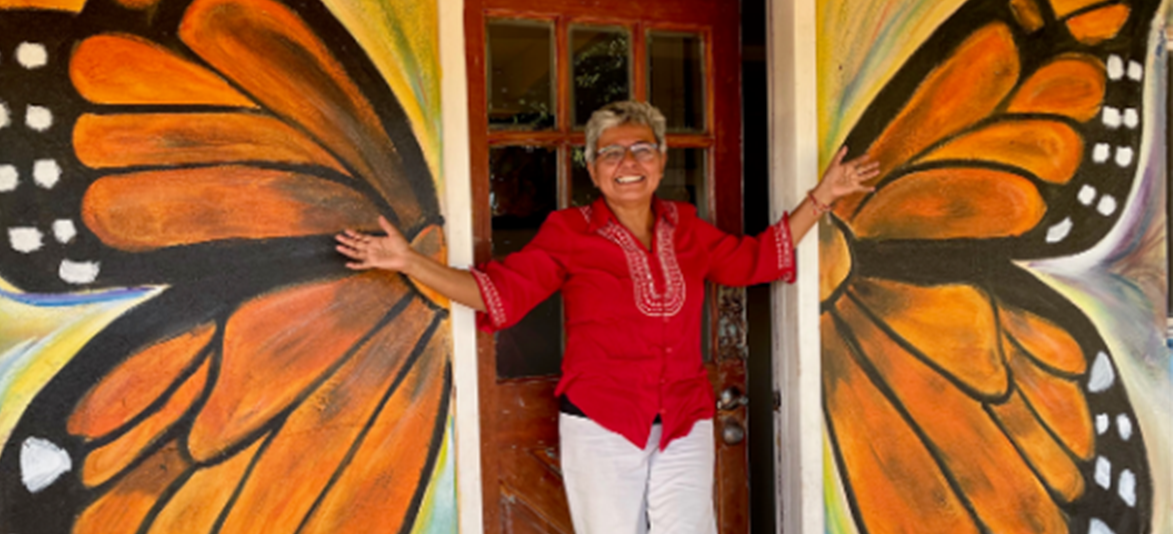
Lika: Well, my name is Alma Angelica Macías. Everyone knows me as Lika. La Casa de la Misericordia started out as a soup kitchen for children and people who had come to look for work in the manufacturing plants. Nogales was once a manufacturing boom town. And the children of the people who came from other states to work here were left behind. The women, who were generally single mothers, lived here. They worked at night because they were paid better. And during the day, they sometimes fell asleep, and the children went without food.
Q2: Lika, how long ago did it start?
Lika: It was at the end of the…in the eighties. The seventies and eighties. That lasted until 2008. Then I was contacted in 2015 for this project. So I came back in 2015 to continue the project, but it had been illegally taken over. So, this process lasted five years, and in 2018… but I started working in 2018, when the Haitians arrived and the people who came in caravans, who were displaced from the shelters, had already been through all of them and were sent to the streets and went to live in the cemetery. So, civil protection came looking for me and a gringo to see if I could get them out and work with those who were living in the cemetery.
So, the people there didn’t want to go to any shelters because they were being sent there, because they were being kicked out, and I told them that I didn’t have anywhere to take them yet. I told Civil Protection, and they told me that they were going to rent a house, but that they couldn’t take them out, and that I had experience with people on the street, with that kind of people. So, they told me they were going to rent a place and give me mattresses and whatever else was needed.
So, I would go there in the afternoons. I was working at the Pablo de Anda school. I was the assistant principal, and I would take my guitar with me to make the atmosphere more familiar and to be able to go in and convince them. And yes, I spent a whole week going back and forth, and then they said they would come with me. I told them it would be a community effort, no one would be in charge, and everything would be done as a team. And yes, they said yes.
Then, when the pandemic was about to start in 2020, it was the last legal assembly, and that was when, on May 13, they gave me Casa de la Misericordia, and on May 21, I left with all those people, and the house was half destroyed.
So, with all of them, we started working to rebuild it, and since all the shelters were closed, around the end of April, people from other shelters came, and there were more than 300 of us. When we started, there were 70 of us, and when they arrived, there were more than 300 of us in May.
So, I always wanted there to be a school, and I was insisting, insisting, insisting, until the little school finally came. We did all the reconstruction work with the people, creating spaces. There were no beds, so we started making beds. I had some friends from an organization in Australia, and they paid the stores. They would tell me, “Tell us where we can buy iron, because we need iron for beds.” So I would tell them, “Oh, at this place,” and they would pay for what we needed there and bring it to the shelter, and there we would work, work, and work to rebuild everything.
And at first, when the pandemic began, no one wanted to accompany me because they were afraid of getting infected, so I was left alone with the migrants until September. During that time, I started communicating via Zoom with Cruzando Fronteras, which were the churches that were going to support us. They sent us money so we could buy supplies, and we would go to Economax to buy groceries, which we still do to this day. Then, they would send us whatever else we needed via money transfer.
And in September, the school was able to start. We started the embroidery in April of that same year, more or less. The embroidery project began with Valerie, but she didn’t come; Kitty came instead. What’s her name? Katarina? We call her Kitty.
And in September, my sister Chelo came because I had burst a vein, and she said, “I’m going to volunteer with you for about three months.” And look. That’s how we started at the shelter.
Q3: What are your roles at La Casa de la Misericordia? What is your daily routine at the shelter?
Lika: Well, for me, I’m the one who keeps in touch with the organizations that support us. So almost every day I have a meeting with one of the organizations, I’m at the shelter, interacting with people, seeing what’s going on, not supervising. What I’ve done is let them be the ones with the keys, in charge of running things, and I meet with them to evaluate how they feel and how we’re doing. And, I’m the one in charge of all external relations.
Q4: In what ways do you support the women in processing trauma and navigating uncertainty? How do you create a culture of trust and safety within the shelter?
Lika: Well, the space is safe because when the shelter first started, I was a missionary, so I was involved in the process of buying the property and working with the neighborhood when it was a soup kitchen.
And the people who live in the neighborhood know me and appreciate me, and they appreciate the place because they eat there and they take care of it, which is very important. Another thing is my experience with liberation theology and other issues, my studies in communication and social work. These are tools that helped me to create this community, and now we have the support of psychologists, which has helped people feel safe. I’ve had a lot of experience in building communities where I’ve been.
Q5: In the last 6 months, immigration policies have changed. How do you help the women maintain hope for their futures? What changes do you hope to see in immigration policy in the coming years?
Lika: Well, when these things happen, there are organizations in the United States or elsewhere that get organized. Generally, for example, lawyers and institutions that have some power in Congress. They take action such as suing the government for asylum rights, etc. And then we have contact with one of these organizations that helps us keep hope alive and tells us not to despair. We have won three out of five resolutions. So, we are going to wait and see how the next one goes. That gives hope to those who stay. Many had to go out to work because when they came, they borrowed money. Then, they get to the United States, and once they get through, they pay back the money. But now, with these conditions, they said we have to go out and work somewhere where they won’t persecute us. We pay, and then we go back to the shelter.
Another thing that gives them confidence and hope and strengthens them is those who visit us and support us. For example, with BYTE, there is a very nice relationship between the entire population because they support us and feel safe. When Save the Children was here, it was also a certainty, but Save the Children is no longer here.
But it’s important that this kind of support and accompaniment continues because it’s what gives them strength, knowing that there are people who appreciate us, who support us, who help us.
Q6: How do you view art and embroidery as a form of storytelling? What impact have you seen on the women who explore creative expression, and how does it help them process their situations?
Lika: Look, I’ll tell you what I think about an embroidery that just arrived. I said, “That’s outrageous! We’re not going to sell that embroidery. We’re going to keep it here to motivate everyone. It says, ‘With every stitch, I remember myself; with every thread, I rebuild myself.’ Knitting and embroidering isn’t just creating; it’s returning to myself. It’s gently putting down roots and blossoming from within.”
Yes, embroidery has a contemplative effect. As they concentrate on the stitches they are making, their breathing slows to the rhythm of their heartbeat, calming them. It helps them focus and transform their pain. They meditate on it and do it as if it were art. It becomes something magical, and they no longer realize that their trauma is transformed when they finish their embroidery. Each piece of embroidery is full of thoughts and transformations, but it also has a physical, psychological, and spiritual effect because it takes them to a spiritual and contemplative plane. This has already been proven.
Q7: Have you stayed in touch with any of the women who have immigrated to the United States, and are there any stories you remember that you would be able to share?
Lika: Well, regarding embroidery, there are several women who share their embroidery experience and have been invited to universities to share that experience. One of them, Wendy, embroiders earrings, bracelets, and she embroiders everything, and her life revolves around embroidery. She is a fulfilled woman, and she learned to embroider here.
Q8: Do you have any favorite memories from the embroidery workshop or from your time at La Casa de la Misericordia?
Lika: Every day is different. It’s so much, so much. I mean, I was shocked to see men embroidering. I had never seen men embroidering. It was always women. And every day there are new experiences. Most of the people who have stayed at the shelter, I think they’ve made at least one blanket each, at least. I mean, everyone has embroidered.
In addition to the adults, children have also participated. Valeria, Tadeo, and Cris, so many children have also participated by making art and embroidering. So I think that at the Casa de la Misericordia, this has made a big difference in the progress of each of the people who are there. Art is part of their inner healing.
Most of them say, “Oh, you don’t know how I arrived and how I’m leaving, rebuilt.” That’s what they usually tell us.