
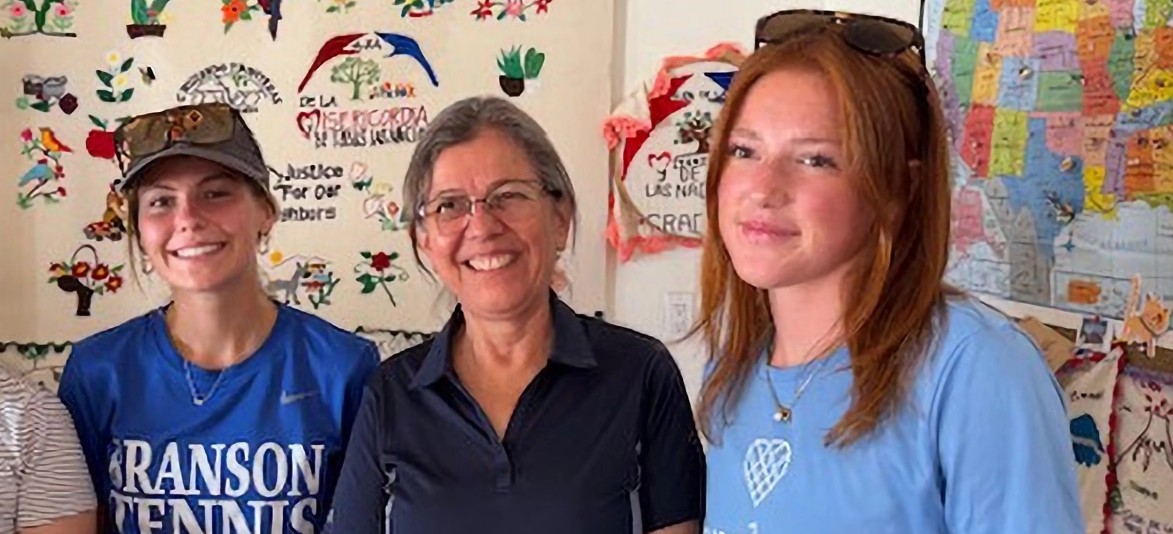
Q1: What is your name, where are you from, and how did you become involved with the shelter?
Consuelo: My name is Consuelo Macias. I am Lika’s sister. My role at the shelter is to manage it. How did I get involved? I started taking care of the shelter on my own during the pandemic in 2020. Then, one day, we were on a video call with the whole family, and I told her I was going to go help her. That was in August 2020, and a week later, she asked me, “When are you coming?” I told her, “In December, when you come back, because the whole family gets together for Christmas. We’ll see.”
There were about 300 people in the shelter, and I said, “I’m going to come and help you.” That call was in August. And then she asked, “When are you coming?” And I said, “In December, I’m going to come and help you. Once you come with our family to spend the December holidays, I’ll go with you back to Nogales.” And then she said, “No, I have to go now.” And then she said, “No, no.” And then I went back and started getting involved in the work with the house. And since then, I thought, “I’ll go back in six months,” but I didn’t. I stayed.
Q2: How has the immigration and refugee process been affected over the last few years?
Consuelo: We have had to go through several processes, or at least I have. Because just when the shelter started, Donald Trump’s administration was coming to an end, and Biden was about to take office. So, I was in the middle of that process. But at that time, the border was closed due to the pandemic. So, it was a different process because even though the border was closed, there were mechanisms in place for people to enter. That was the exception to Title 42.
Then that option ended, and enforcement began. It’s called CBP1. That was a mechanism where people could enter in an orderly manner. So, people would apply for entry through a smartphone. Then they would wait, and there were a lot of people trying to enter through that app. My head was everywhere. I think they do it little by little because otherwise they wouldn’t be able to. And although it seemed like an easy mechanism, it wasn’t. It was very complicated, but there was that mechanism and there was that possibility of entering. Because the average wait time for them to be given an appointment started out at three months, then four, then five, then six months. Finally, they were waiting up to a year for an appointment. But they had hope that they would be able to get in.
During that waiting period, the shelter allows them to wait as long as necessary. And during that waiting period, people receive legal training, they wait by doing embroidery, which has a waiting time, and they start or learn techniques to wait as long as necessary to be able to cross.
Now, what happened when it closed completely? Most of the people here fall into a state of total depression. It was a huge blow to everyone here. At that moment, there is no possibility.
However, people continue to wait to see if there is a possibility. Most of them were expelled from their homes.
Right now, the people who are here cannot return home because they have nothing. There is nothing for them to return to, so they cannot wait at home.
Q3: Can they stay in Nogales, Mexico?
Consuelo: As it is a shelter, yes. In fact, many of the people who are here are looking into the possibility of legal residency.
Q4: What are some of your daily tasks, and what is your role here at La Casa de la Misericordia?
Consuelo: I am in charge of managing the house and making sure the resources are used properly. If something is missing, find a place to source it. The house is run as a community. Everyone is responsible for doing all the activities. Cooking, laundry, garden maintenance, general housekeeping, taking out the trash, keeping an eye on the door, and water management. They do all of that.
Q5: How is the shelter funded? How do you get donations?
Consuelo: There is an organization called Cruzando Fronteras, which is made up of four churches in the United States, and they are the ones who support us with food, gas, and all services. And also because we have a little school. That little school is officially recognized, which means that when the children arrive here, they are immediately enrolled in school so that they don’t miss out on their school year. Sixty percent of our population is under the age of 17 and needs to go to school. And for the teachers, we have to find resources to pay them.
Q6: How do you support the women in the shelter when they have been through traumatic situations? How do they open up to you?
Consuelo: We now have the support of a permanent psychologist. It should also be noted that the majority of our population is female. So we always have that space for them, depending on the type of problem they bring, whether they require psychological or legal assistance. Because many of them come fleeing domestic violence. We have to file the relevant complaints and provide all the legal advice they need so that they can continue with their cases.